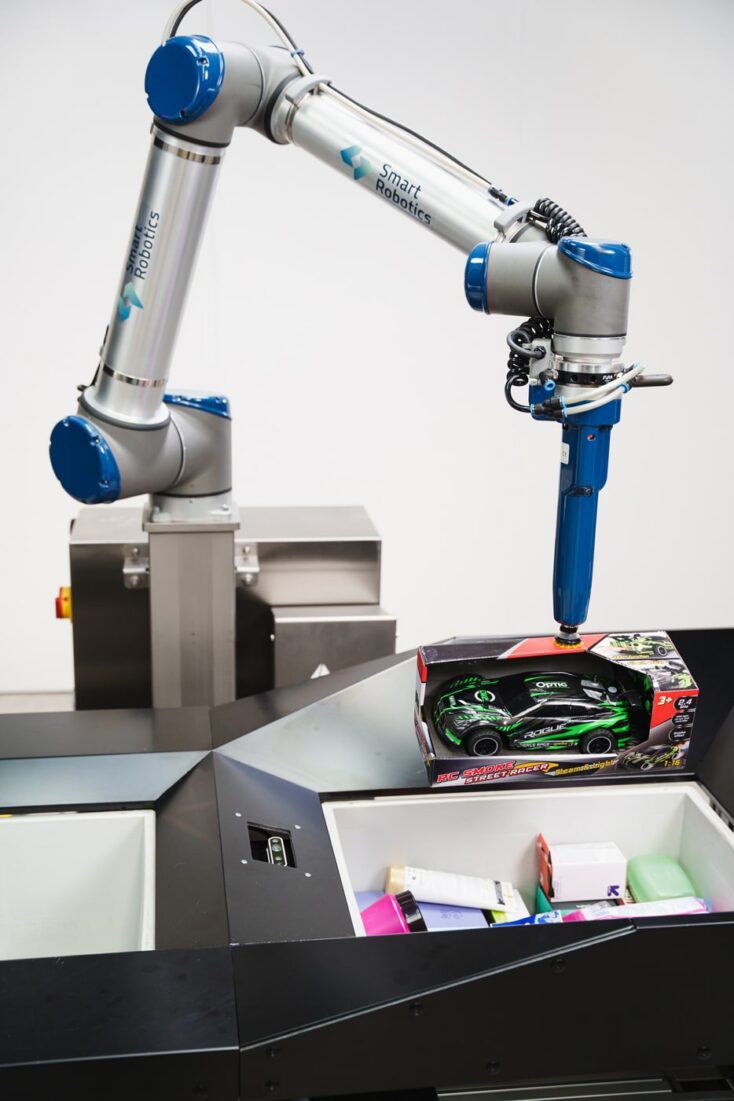
System testing evaluates the behavior of a pick and place solution as to prevent any unexpected system failure in a live customer environment. It validates the fully integrated application, including additional components such as buffering systems.
Types of system testing
- Happy-flow tests are used to check default scenarios and functions of the robot, e.g. correctly picking and placing boxes on a pallet.
- Error-handling tests makes sure all possible causes for system errors are tested.
- Recovery tests are performed to demonstrate that you can successfully recover the cobot from possible errors and exceptions.
- Configuration tests use different possible configuration of software and hardware to ensure the application works well in all needed states.
- Extreme tests are used to ensure the cobot system will work properly under extreme conditions, e.g. testing different box sizes and weights.
- Endurance tests are performed to test the happy-flow of a cobot over a significant amount of time.
Stable and reliable pick and place system
As has been described above, using system testing to test a pick and place robot as a whole is an important part of any successful quality control process. After all, one needs to ensure the cobot will be fully functional at the customer and will perform its tasks as required. That is why system testing has been implemented within Smart Robotics; to ensure we deliver stable and reliable palletizer, item picking and parcel picking systems to our customers.